
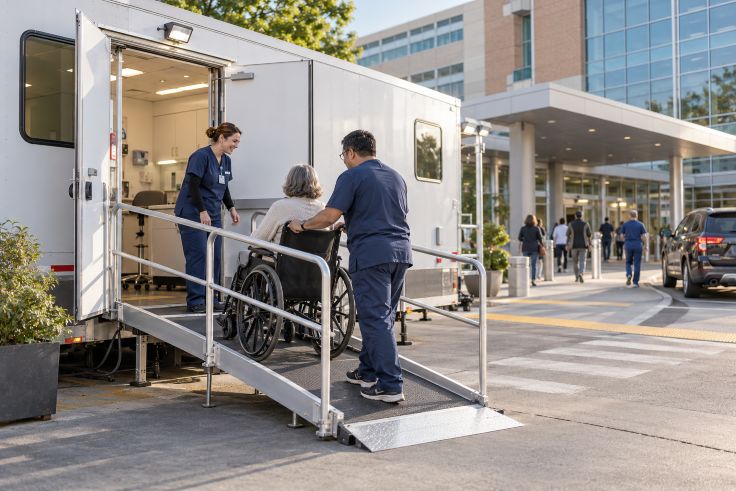
Emergency medical teams provide additional care when disasters and disease outbreaks overwhelm local resources. The U.S. Administration for Strategic Preparedness and Response describes roles that include emergency treatment, patient movement, and relief for crowded emergency departments. Temporary facilities give these teams somewhere to work, helping health services manage demand while permanent hospitals remain under pressure.
A mobile hospital is one approach to creating that additional space. Deployable facilities may use transportable units or temporary shelters, depending on the mission. The World Health Organization describes field hospitals and clinics as deployable clinical capacity. Their value depends on trained personnel, suitable equipment, and integration with the wider health system.
Added Capacity Needs a Clear Purpose
The first planning question should be what care the community needs. A temporary outpatient service has a different role from a facility equipped for inpatient treatment. The World Health Organization identifies outpatient care, emergency management, stabilization, and referral among emergency medical team functions. Planners should define the intended services before selecting equipment or announcing availability.
A Philippine example illustrates this flexibility. A joint release from the Department of Health, Philippines and the World Health Organization explains that Philippine Emergency Medical Assistance Teams can support existing facilities or operate independently in temporary health tents. This makes deployment a service decision as much as a construction or transport task.
Triage Establishes Who Needs Care First
Triage sorts patients by how urgently they need intervention. The Interagency Integrated Triage Tool, developed by the World Health Organization, the International Committee of the Red Cross, and Médecins Sans Frontières, provides protocols for adults and children. Its routine system distinguishes patients who need immediate attention from those who can safely wait.
That distinction helps organize the entrance to a temporary facility. The practical aim is to direct each person toward an appropriate assessment or treatment area. Planners should make the intake process understandable to patients and accompanying relatives, with clear responsibility for deciding where someone goes next.
Overwhelming casualty numbers require a specific response. The World Health Organization provides separate mass casualty guidance for situations where patient demand exceeds a facility’s usual resources and procedures. Teams should establish when that guidance applies rather than assume ordinary queue management will remain adequate throughout an emergency.
Diagnostics Must Match the Clinical Mission
Testing capacity also needs a defined purpose. The World Health Organization explains that rapid response laboratories address diagnostic gaps and provide additional capacity during emergencies. Its 2025 operational standards emphasize quality, safety, coordination, and compatibility with other response assets. Bringing testing closer to patients still requires a dependable diagnostic service.
For planners, this means asking which investigations can be performed locally and which require another laboratory. Equipment selection should follow that answer. Teams should also establish how results reach the treating clinician and accompany a patient who is transferred. A test has limited practical value if its result disappears between services.
Treatment Depends on People and Resources
The World Health Organization describes emergency teams as capable of treating acute illness and injuries within their service scope, while stabilizing patients who need higher-level care. Its Emergency Care Toolkit recommends a designated resuscitation area with essential resources close at hand. Temporary space should therefore be organized around the care teams can actually deliver.
Personnel requirements extend beyond doctors and nurses. The U.S. Administration for Strategic Preparedness and Response lists pharmacists, respiratory therapists, logistics specialists, safety staff, and communications personnel among disaster team members. Their combined responsibilities show why additional beds alone are an incomplete measure of readiness. Planning should account for the whole team.
Referral Connects Temporary and Permanent Services
Referral needs a shared process. The World Health Organization offers an Acute Transfer Checklist and an Acute Referral Form to support preparation and communication between facilities. These tools help teams document a patient’s condition and needs. Before opening, planners should agree on receiving services, transport arrangements, and responsibility for coordinating transfers.
Families should receive a clear explanation of the next stage of care. Useful questions include where the patient is going, who will accompany them, and how information will be shared. Those arrangements should be settled before an urgent transfer becomes necessary.
Practical Limits Shape the Lasting Benefit
Operational readiness includes supplies and basic infrastructure. The Philippine verification process reported by the World Health Organization assessed clinical management, logistics, water, sanitation, and hygiene. Planners should also examine whether patients and supply vehicles can reach the site reliably. A suitable location must work for daily operations, alongside its clinical layout.
Staffing and resupply plans should be reviewed together. Decision makers should ask who will cover each shift, which supplies need replenishment, and what happens if deliveries are delayed. Opening hours and advertised services should reflect those answers throughout the deployment period.
Continuity deserves equal attention when deployment ends. The World Health Organization provides a Counter-Referral Form for communicating follow-up needs to primary care or the original facility. A clear handover plan should also consider patients’ ongoing needs, connecting emergency treatment with broader approaches to health and well-being. Deployable care makes a lasting contribution when patients remain connected to appropriate services after the temporary treatment space closes.